
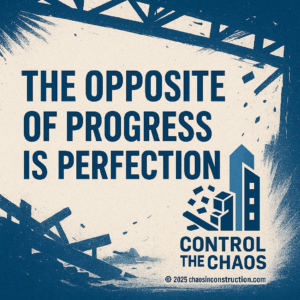
It’s a quote that hit me hard when I first heard it from a senior manager. At first, it sounded backwards. Isn’t perfection what we’re all chasing? Isn’t our job as builders and managers to make sure things are done right — no compromises?
But in construction — where drawings evolve, timelines slip, and conditions change — perfection often becomes the biggest obstacle to forward motion. This is where Construction Chaos Theory kicks in. Because perfection doesn’t just slow you down — it paralyzes your ability to adapt. And that’s where projects begin to break down.
🚧 The Problem With Perfection
Perfection feels like the safe path. But it’s actually a trap. It demands more detail, more revisions, more time — and in the real world, we don’t have unlimited budgets or ideal conditions.
Let’s take design documents. Ideally, we’d love a 100% complete, fully coordinated set of plans before bidding. But that’s rarely reality. Every project ends up needing field adjustments, design clarifications, rework, and — let’s be honest — owner-driven changes. What we actually need isn’t perfection. We need a buildable set of drawings. Clear, concise, and coordinated enough to move forward without creating chaos.
Or consider material selection. The best pipe, fixture, or system might exist on paper, but if it’s three times the cost and has a 22-week lead time, it’s no longer the best solution — it’s a delay risk. You can’t build with unavailable perfection.
Perfection tries to eliminate risk. Progress manages it.
⚙️ Progress Means Getting Things Done
Let’s be clear — “good enough” does not mean careless. It means delivering work that is safe, compliant, efficient, and timely — without obsessing over unrealistic standards.
In construction, you must keep the job moving. And that means making decisions, solving problems, and executing work even when things aren’t perfect.
- A design that’s 80% detailed — with flexibility for field resolution.
- A schedule that’s logically built — but allows for in-field sequencing changes.
- A team that can make a call with 70% of the info — and adjust when needed.
That’s how real jobs get built. Not by sitting in meeting rooms chasing flawless solutions, but by **acting with purpose** and **adapting as needed**.
“Momentum builds clarity. Perfection demands paralysis.”
🔁 Perfection Paralyzes. Progress Produces.
When perfection becomes the goal, here’s what happens:
- Decisions get delayed
- Schedules fall behind
- Teams freeze — afraid of doing the “wrong” thing
But when progress is the goal:
- Action drives clarity
- Problems get addressed
- The project moves forward
Perfection seeks control. Progress builds confidence.
You don’t need every answer up front. You need a defined starting point, a commitment to act, and a system ready to adjust when reality kicks in.
🎢 Construction Chaos Demands Forward Motion
At Chaos in Construction, we live by the mantra: “Nothing is anything until it’s defined.” But we also know that nothing gets built if we wait for perfection.
Construction is full of moving targets. Designs change. Site conditions shift. Teams rotate. If you’re always waiting for the ideal — the flawless — the perfect — you’ll never pour concrete, never turn wrenches, never close out a job.
Progress isn’t about rushing. It’s about making informed decisions and moving forward with confidence — even if things aren’t perfect.
📥 Ready to break the perfection cycle?
Download our free Project Ripple Map to start identifying decision bottlenecks and downstream impacts on your schedule and team.
👉 chaosinconstruction.com/cct-library
© 2025 chaosinconstruction.com | All rights reserved.
Discover more from Chaos in Construction
Subscribe to get the latest posts sent to your email.