
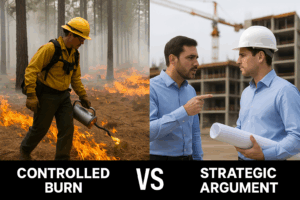
I argue a lot at work. Not because I enjoy it, and not because I’m trying to prove a point, but because construction management requires it. Well, maybe because I enjoy it a little… But what I’ve learned, though, is that you can’t argue for the sake of just arguing. Disagreement alone doesn’t establish authority—just like blind agreement doesn’t build credibility either.
In construction management, relationships matter. But these aren’t the same kind of relationships you build over dinner or coffee. They’re relationships forged under pressure, surrounded by deadlines, budgets, and jobsite chaos. The foundation isn’t agreement or disagreement—it’s respect. And respect in this business must be mutual.
That’s why when you know you’re right, you must stand your ground—even if it sparks conflict. And when you know you’re wrong, you must own it immediately. That balance is what builds true respect.
Not long ago, an authority figure told me I argue too much—that it’s not doing what I think it’s doing. My response was simple: “Sometimes projects are like forest fires. If you want to stop the spread, you need to burn a few trees in strategic areas.”
That’s what I see as the role of a strategic argument. It’s uncomfortable. It disrupts the moment. It may even char the edges of a relationship. But if it prevents the entire project from burning down, it’s worth it.
So what do these controlled burns look like in construction management? They usually aren’t about trivial preferences or stylistic differences. They’re about the non-negotiables:
- Enforcing critical safety policies.
- Holding firm on contract terms and conditions.
- Protecting quality standards that can’t be compromised.
- Defending the project schedule when the critical path is at risk.
These are the areas where you can’t afford to let things slide. If you do, the spark grows into chaos.
Example in Practice: Pushing Back on Scope Creep
Imagine the contractor decides to add a few “minor” changes in the field without following the change-order process. Maybe they want to swap in a different valve, reroute a line, or adjust a piece of equipment placement “because it’s easier.” On the surface, it might look harmless—something you could just let slide to avoid a fight.
But this is exactly the type of spark that becomes wildfire. If you don’t push back immediately, you’ve set a precedent that contract terms are optional. Suddenly, the scope starts creeping in all directions, costs balloon, and accountability disappears.
A controlled burn here means drawing a hard line: “That’s not part of the approved scope. If you want to propose a change, submit it formally for review and authorization.” It may ruffle feathers in the moment, but it prevents far bigger chaos down the road.
Example in Practice: Choosing Not to Light the Fire Yet
Now picture a heated coordination meeting where an O&M representative starts pressing for a last-minute change that isn’t realistic. Everyone in the room is tense, and the discussion is teetering on unproductive. You could ignite the argument right there—but the timing is wrong.
Starting the fire in that moment risks escalating emotions and turning a controlled burn into a second forest fire. Instead, you take note of the issue, acknowledge their concern, and table the discussion: “I hear your point, but this deserves a calmer review. Let’s regroup tomorrow with the drawings and options on the table.”
By holding off, you preserve respect, maintain control of the room, and move the battle to terrain where conditions are safer. When the fire does need to be lit, you’ll be in a better position to control the outcome.
And here’s where Construction Chaos Theory comes in. A single spark in a dry forest is an initial condition—the tiny event that sets off a chain reaction. In projects, that spark might be a missed definition in the contract, an overlooked detail in a schedule, or a bad assumption that slips by unchecked. Left alone, it ripples through the entire job until chaos takes over.
Sometimes, the best way to control that chaos is to start a controlled burn—a strategic argument. By addressing the issue directly (even if it means temporary conflict), you cut off the spread before it consumes everything else.
The key is how you argue:
- Don’t raise your voice.
- Don’t curse.
- Don’t attack the person.
Stay factual. Stay professional. Respect must be the thread running through every disagreement. If you maintain that respect, then the other person’s offense is their burden—not yours.
In the end, arguments in construction management aren’t about ego or dominance. They’re controlled burns—small, intentional fires that protect the forest from disaster. If the other person can’t see that, maybe they’re part of the wildfire themselves.
Discover more from Chaos in Construction
Subscribe to get the latest posts sent to your email.