
In construction management, leadership isn’t just about knowing the work—it’s about knowing where to focus your energy, when to intervene, and how to keep the entire operation from spiraling into chaos.
One of the fastest ways to let chaos take over a project is to do something that looks like progress, feels like problem-solving, and even gets praised by others—but actually avoids the real issue:
🎯 Don’t Sidestep the Starting Point
We’ve all done it.
- When a task falls through, we go to the next person.
- When someone’s underperforming, we quietly assign the work elsewhere.
- When a process is broken, we build a workaround that “keeps things moving.”
It feels efficient. It gets the ball rolling. But it’s a sidestep—and that sidestep becomes the new initial condition that defines your project’s future chaos.
🏉 The Rugby Analogy: Lateral Motion in Leadership
American football players run north and south—straight up the field. Rugby players move laterally, scanning for a break in the line. Progress happens when they finally cut forward.
Most teams these days operate more like rugby. When something breaks down, we don’t face it—we go around it, hoping someone else will plug the gap. That might work for a moment, but it sets up the next person for rework, delay, and frustration.
But here’s the key: At some point, even in rugby, you have to stop sidestepping and run forward—into the defense.
Sidestepping buys time, but it doesn’t solve the problem. Scoring—real progress—requires courage, force, and direction. The same goes for construction management.
The strongest leaders don’t just look for open paths. They create them.
🐸 “Eat the Frog” Meets Construction Chaos Theory
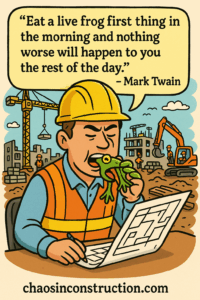
There’s an old productivity phrase: “Eat the frog.”
The metaphor comes from Mark Twain, who said:
“If it’s your job to eat a frog, it’s best to do it first thing in the morning. And if it’s your job to eat two frogs, it’s best to eat the biggest one first.”
The “frog” is the most uncomfortable thing you need to do—the conversation you don’t want to have, the decision you’ve been avoiding, the task you hope will resolve itself.
But it won’t.
And in Construction Chaos Theory, every avoided task becomes a ripple that spreads. That first sidestep is your initial condition. What follows is out of your control—unless you face it immediately.
🔁 Sidestepping in Action (And How It Backfires)
Example: A contractor fails to submit final valve cut sheets.
Instead of holding them accountable, the PM copies submittals from a previous project to keep things moving.
Now:
- The engineer reviews an incorrect spec.
- The supplier fabricates the wrong item.
- Field installation is delayed.
- The O&M manual has to be reworked.
The real issue wasn’t the valve. It was the failure to confront the problem at the start.
🛠 What “Don’t Sidestep the Starting Point” Looks Like
This principle fits between:
- Chaos Theory Principle #1: Control the Initial Conditions
- Chaos Theory Principle #2: Map the Ripple Effects
But this is the human side of those principles. Most ripples don’t come from technical systems—they come from people sidestepping what they should have addressed early.
What real leadership looks like:
- 📌 Address underperformance early—don’t silently reshuffle work.
- 📌 Fix broken processes—don’t offload the impact onto others.
- 📌 Get clarity now—uncertainty today is rework tomorrow.
🧠 How This Makes You a Better Leader and Construction Manager
“Don’t sidestep the starting point” isn’t just project advice—it’s leadership development in disguise.
Every decision to face a problem head-on strengthens your role as the project’s anchor. It reinforces accountability, speeds up resolution, and creates a culture where people are less afraid to act and more confident in structure.
Sidestepping can feel efficient, but it trains your team to wait for someone else to act. Taking the hit—leading into the issue—trains your team to solve problems and own outcomes.
Great leadership doesn’t avoid pressure. It organizes it and moves forward through it.
⏱️ Don’t Let Problems Fester — Prioritize and Strike
The longer a critical issue lingers, the more damage it causes. And in construction, timely decision-making is everything.
If you wait too long:
- Your options narrow.
- Costs compound.
- Trust erodes.
You don’t need a perfect system to prioritize—just a consistent one.
🔺 The Time Management Matrix (Eisenhower Matrix)
| Urgent | Not Urgent | |
|---|---|---|
| Important | Do Now 🔥 | Schedule It 🗓️ |
| Not Important | Delegate 📤 | Eliminate 🗑️ |
That nagging issue you’re avoiding? It’s likely sitting in the “Important, Not Urgent” quadrant. Don’t wait until it’s a fire—solve it while you have the control.
Other Prioritization Models for Construction Leaders
- The 4Ds: Do, Defer, Delegate, Delete
- 80/20 Rule: Focus on the 20% of issues creating 80% of chaos
- RACI Charts: Clarify who owns what to prevent buck-passing
✅ Key Takeaways for Construction Leaders
- Sidestepping looks productive—but it’s disguised avoidance.
- Every sidestep becomes a new initial condition. Expect ripple effects.
- Don’t aim for ease—aim for impact.
- “Eat the frog” before the ripple becomes a wave.
- Prioritize discomfort—because ignoring it leads to disorder.
💬 Final Word: Step Into the Chaos
You don’t manage chaos by dodging it. You manage it by stepping into it—defining the issue, confronting the discomfort, and owning the outcome.
If you don’t define the starting point, the chaos will define it for you.
Construction chaos isn’t something to fight—it’s something to manage, starting with the very first decision.
🧠 Want More on Construction Chaos Theory?
Check out our full series on how construction leaders can manage disorder, delays, and drama—without losing control of the job.
© 2025 Chaos in Construction | chaosinconstruction.com
Discover more from Chaos in Construction
Subscribe to get the latest posts sent to your email.