
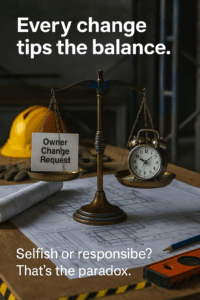
When the Owner says, “I’ll pay more—just make it happen,” the easy answer is “yes.” But the responsible answer might not be.
I’ll be honest: I don’t like making a change during construction. Even when the customer insists they’re fine with the added cost and even when they assure me the schedule slip is acceptable, a part of me clenches up, resisting the impending chaos.
Although that resistance always makes me question myself. Am I being selfish? Am I protecting my comfort and order instead of serving the Owner who’s paying the bills?
Callout: In Construction Chaos Theory, every change is a new initial condition. It doesn’t just add cost—it resets the baseline and launches fresh ripple effects across people, plan, and plant.
Trades must resequence. Procurement gets reshuffled. Commissioning dates shift. Staff training is delayed. And often, what seems like “just a little delay” actually eats away at float, that cushion of time we all rely on. Once float is burned, the next problem hits the project head-on.
The Two Voices in My Head
- If you resist this, you’re selfish.
- If you accept this without pushback, you’re reckless.
It can feel like there’s no right answer. But my job isn’t to reflexively please—it’s to control chaos. Saying “no,” or “not yet,” or “yes, if…” isn’t selfish when it protects the project’s mission: a safe, operable, high-quality facility delivered as promised.
Callout: A late change isn’t a line item; it’s a system shock. Treat it like one.
The Hidden Cost of Float Burn
One of the biggest risks of saying “yes” too quickly is float burn. Float is the schedule’s safety margin, and every change that “only burns float” shrinks that margin. The Owner may accept the delay, but the project has now lost resilience.
With less float, the next disruption—weather, supply chain, labor—pushes directly into delay costs, liquidated damages, or expensive acceleration. Float is currency, and once it’s gone, every problem gets more expensive to solve.
I’ll dig deeper into this in a future post on the cost of float burn, but it’s worth remembering here: what looks harmless on paper can be financially devastating in practice.
The Selfishness Paradox
Sometimes I don’t just resist a change—I catch myself thinking: “This change is selfish. The customer only cares about getting what they want, not what it actually takes to make this happen.”
But here’s the paradox: the moment I label the change as selfish, I’m really holding up my own perspective as the higher truth. I’m saying, “My definition of what matters—schedule integrity, cost discipline, quality, and operations—outweighs theirs.” That can be its own form of selfishness.
It’s a trap. If I let myself believe the other side is selfish, I’m no longer evaluating the request objectively—I’m reacting emotionally. And if I’m reacting emotionally, I risk clouding my judgment.
That paradox shows up outside of projects too. When we accuse someone of being selfish, what we often mean is, “they didn’t consider my needs first.” But by framing it that way, we’re also centering ourselves. The act of labeling someone as selfish can itself be selfish, because it elevates our priorities above theirs.
On the jobsite, that mindset is dangerous. If I avoid pushing back on a bad change just to avoid looking selfish, I fail the project. If I push back while labeling the request selfish, I damage trust. Either way, chaos grows.
From Blame to Evaluation
The only way out of the paradox is objectivity. Step outside of selfishness altogether and evaluate the change on its merits. Instead of asking, “Who’s being selfish?” the real question is: What outcome best protects the mission of the project?
Use this quick lens:
- Does this change align with the project’s mission?
- Does the benefit outweigh the chaos it introduces?
- Will the ripples—delays, float burn, added cost—create more harm than good?
When I frame the decision this way, the guilt disappears. I’m not defending my ego or attacking someone else’s motives—I’m protecting the project. Saying “no” becomes responsible. Saying “yes” becomes strategic.
Final Word:
I’ve come to believe selfishness isn’t always wanting the best for yourself. Sometimes it’s insisting that your definition of fairness is the only one that counts. On a project, that mindset leads nowhere. What matters is controlling the chaos.
So no, it’s not selfish to resist a change. It’s selfish to let guilt or pride dictate the response. A Construction Manager’s responsibility is bigger than that: define the ripples, show the tradeoffs, and protect the project’s integrity.
Changes aren’t the enemy—unmanaged ripples are!
Related Reads (Chaos in Construction)
- Controlled Burns: The Role of Strategic Arguments in Construction Management — when pushing back is the responsible move.
- Stop Putting Specs in the Drawings—Fix the Real Problem — align information so changes don’t spiral.
Discover more from Chaos in Construction
Subscribe to get the latest posts sent to your email.