
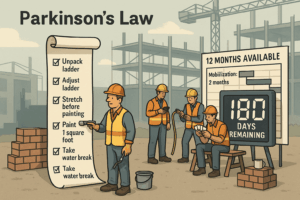
Parkinson’s Law is one of those concepts that wasn’t written for construction—but might as well have been.
“Work expands to fill the time available for its completion.”
You’ve seen it. I’ve seen it. And if you’ve been around construction long enough, you’ve probably experienced the consequences firsthand. What starts as a tightly planned timeline somehow bloats out to fill every available day, week, and month—even when the work could’ve been done sooner.
🧠 It’s Not a Theory. It’s a Pattern.
In my experience managing projects, I see this pattern again and again—on both sides of the construction fence.
Design engineers stretch their work to the deadline. Contractors pad durations to eat up available calendar time. And when a project delay hits—even one they didn’t cause—they treat it like a hall pass to coast. Their urgency disappears.
It’s rarely malicious. Sometimes it’s laziness, sure. But more often it’s just human nature reacting to a system without clear boundaries. When people are given more time, they use more time. Not because they need it. But because it’s there.
🏗️ How It Plays Out on a Construction Project
Scenario:
A project milestone slips by 30 days due to a major equipment delivery delay. The electrical subcontractor, whose work wasn’t scheduled to begin for another 60 days, sees the update and thinks, “Great—we’ve got time.”
So they push their crew start back a few weeks, pull people to another job across town, or slow-play submittals they could’ve turned in this week.
But here’s the danger: that delay might get fixed.
If the delivery arrives early or the GC pulls the schedule back on track, that electrical sub’s “bonus float” vanishes overnight. Now they’re behind. And they’re the reason the schedule is slipping.
🧨 Float Isn’t Free—and It Isn’t Yours
This is where a lot of teams get burned.
Float is not a prize. It’s not a cushion for whoever gets there first. And it definitely isn’t something you get to create just because someone else caused a delay.
Unless your contract explicitly defines float ownership—and most don’t—the industry default is that “the project owns the float.”
That doesn’t mean every stakeholder can start helping themselves to it. It means:
- Float is communal
- Float must be preserved
- Using float requires coordination—not assumption
⚖️ Contract Language Matters (But So Does Discipline)
Regardless of what your spec section says, here’s what should happen:
- Track delays carefully.
- Don’t adjust work pace based on someone else’s delay.
- Assume float can disappear at any moment.
Because if the float shrinks—and you used it without permission—you’ll likely have to accelerate at your own cost. The contract doesn’t owe you float you never had.
🛑 The Silent Schedule Killer: Complacency
Let’s call this what it is: a leadership issue.
When one delay occurs and other trades back off without direction, that’s not “strategic rescheduling”—that’s passive mismanagement.
Slowing down without a plan is often worse than rushing. Because:
- Materials may still show up on time
- Crews and equipment may get reassigned
- Milestones start missing without explanation
- Trust between contractor and owner breaks down
This kind of creeping chaos is hard to catch in real time—but it always shows up in the post-mortem.
🧠 Why Parkinson’s Law Persists (and How to Stop It)
People don’t misuse time because they’re malicious. They do it because the system lets them.
Here’s how to stop it:
- Create pressure, even if it’s artificial
Use milestone reminders and regular check-ins to keep urgency alive. - Require transparent scheduling
Expose float. Don’t allow inflated durations to hide it. - Document delay ownership
Don’t let other trades assume their start dates moved. - Watch for resource reassignment
If a sub pulls crews off your job, that’s a red flag.
💡 Final Word: Float Is a Strategic Asset, Not a Free For All
Letting Parkinson’s Law stretch your project timeline may feel harmless—but it creates a dangerous illusion of progress. It leads to situations where trades fall behind and are forced to catch up on their own dime.
As a construction manager, your job is to recognize the signs early, communicate expectations clearly, and preserve urgency—even when it feels like there’s time to spare.
Because that time can vanish overnight. And when it does, the ones who coasted will be the ones chasing the schedule.
🧱 Have you seen Parkinson’s Law play out on your job site?
Share your experience below or subscribe for more posts on managing construction chaos.
Leave a comment below ⬇️ (All comments are held for moderation.)
📩 More Construction Chaos Theory Insights
© 2025 Chaos In Construction. All Rights Reserved.
Discover more from Chaos in Construction
Subscribe to get the latest posts sent to your email.