
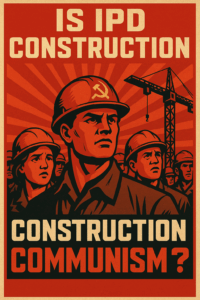
We’re told that Integrated Project Delivery (IPD) is the future of construction. That shared risk and reward leads to stronger collaboration. That hierarchy is old school, and what we really need is equality, empathy, and transparency.
But the more I read about IPD, the more it reminds me of something else.
Not innovation. Not efficiency.
Communism.
IPD in Theory: Utopia on Paper
For those unfamiliar, Integrated Project Delivery is a contracting method that joins the owner, architect, engineers, and contractor into a unified team early in the design phase. They share the financial risk and reward based on project outcomes—schedule, cost, quality.
In theory, it’s beautiful: no more change order wars, no more adversarial silos, no more hiding behind contract language.
Everyone wins together.
Or loses together.
And that’s where the trouble starts.
Shared Risk = Shared Chaos
If everyone owns the risk, then no one owns the problem.
This is the paradox at the heart of IPD. When responsibility is evenly distributed, accountability becomes diluted. Problems become communal property—easy to talk about, harder to solve. You need consensus to act. And consensus, in construction, is a luxury you often can’t afford.
The result? Chaos shared equally across the team. Like water pooling in the lowest spots of a jobsite, it finds its way into every crack. And with no single entity responsible for pumping it out, the whole project slowly sinks.
When Collaboration Becomes Compromise
The truth is, IPD doesn’t eliminate conflict. It just forces everyone to be nice about it.
But when everyone’s trying to be “collaborative,” no one is drawing a hard line. Strong firms are asked to slow down for the weak. Productive teams are held back by the underperformers. The fastest skater has to match the pace of the one limping behind.
That’s not teamwork. That’s a handicap.
And it breeds the same behavior you see in socialist or even communist systems: people only give as much effort as the least motivated person on the team. Why? Because there’s no reward for outpacing the group—and no penalty for falling behind.
Parkinson’s Law Still Applies
You can’t legislate urgency into a team. You can’t spreadsheet your way into motivation.
Parkinson’s Law states that “work expands to fill the time available for its completion.” This law shows up on nearly every jobsite—especially when nobody feels the heat of ownership. The more time a team is given, the more they’ll use, whether they need it or not.
And just because IPD promises shared goals and mutual respect doesn’t mean that law disappears. In fact, it often gets worse—because when everyone shares the reward equally, the incentive to hustle fades.
IPD is marketed as a way to eliminate inefficiency, but it often institutionalizes it. The bigger the team, the more complex the coordination, and the slower the movement. Collaboration turns into choreography. And in construction, choreography doesn’t pour concrete.
👉 Want to dive deeper? Read my full post: Parkinson’s Law on the Jobsite: Why More Time Always Gets Used
No Hierarchy = No Clarity
Just this week, I received an email from a consultant summarizing how the EJCDC documents handle conflict:
“The EJCDC encourages that contract documents should be complementary, and not have an imposed order of precedence… Conflicts between documents should be resolved through careful review and interpretation.”
Read that again.
No hierarchy. No clear leader. Just “interpretation.”
That’s the IPD mindset: if we all work together, we’ll naturally find a shared understanding. But in construction, that rarely happens. Interpretation is a lawyer’s game. On the ground, what you need is a clear chain of command. One lead. One decision-maker. One source of truth.
Control Requires Structure
In my blog post about construction managers and hockey players, I said it plainly: you’re only as good as the weakest player on your team. And the strongest one? He can’t cover every position. He can’t backcheck and score and defend the goal.
Structure matters. Hierarchy matters. It’s not oppression—it’s clarity.
In IPD, structure gets flattened in the name of fairness. But flattening structure doesn’t remove risk—it just spreads it until it becomes unmanageable. The weaker partners want shared risk because they can’t manage it. They want shared chaos because they can’t control it.
And so we handicap the best, slow down the fastest, and congratulate ourselves for calling it “equity.”
Conclusion: Construction Needs Leaders, Not Utopias
I get why IPD appeals to owners and consultants—it promises peace. But peace is not the same as progress. And in a world where delay, defect, and disorder are always waiting to seep in, you don’t fight chaos by flattening leadership.
You fight it with discipline.
You fight it with responsibility.
And You fight it by knowing who owns what—and holding them to it.
IPD, for all its good intentions, forgets that. And when a system forgets how to reward performance or enforce accountability, it’s no longer a delivery method.
It’s construction communism.
What do you think?
Have you worked on an IPD project? Was your experience different—or the same? Let me know in the comments below.
Explore more: Visit chaosinconstruction.com for more straight-talk analysis, field-tested insights, and tools for managing construction chaos.
Discover more from Chaos in Construction
Subscribe to get the latest posts sent to your email.

Leave a Reply