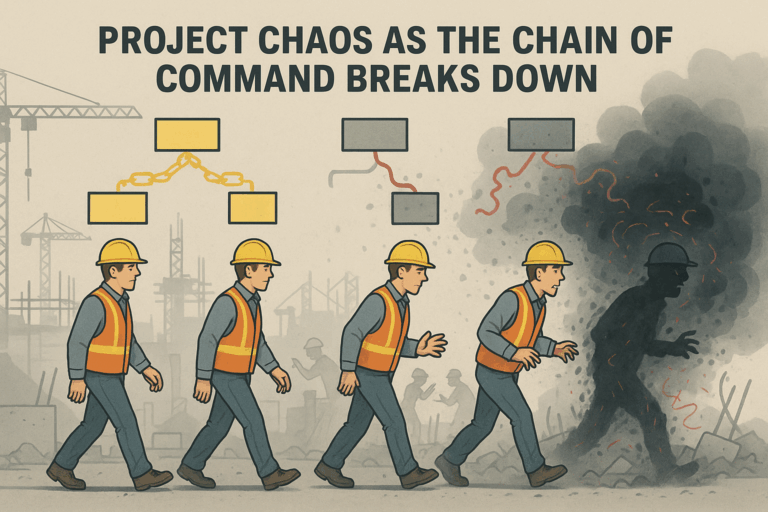


Construction projects rarely fall apart in a single dramatic moment. More often, chaos creeps in like a chess game gone wrong — one move at a time. A missed submittal here, a delayed material delivery there, a contractor’s oversight that no one admits to until it snowballs into a major schedule or cost impact.
As Construction Managers, we can’t afford to react impulsively. We have to think like chess players: planning not just our next move, but the next nine moves — anticipating reactions, counter-moves, and the ripple effects that follow.
The Chessboard of Construction
Every project has its pieces♟️: contractors, subcontractors, designers, suppliers, inspectors, and the Owner. Each piece has its own capabilities, limitations, and predictable tendencies. Just like in chess, the order of moves matters. Sometimes the best strategy isn’t to push your advantage immediately, but to let your opponent reveal their own weaknesses.
Exposing the Move
In construction disputes, truth matters — but timing matters even more. There are moments when jumping in too early, pointing fingers, or forcing a confrontation only fuels the chaos. Instead, it can be more effective to create the conditions where the contractor documents their own missteps:
- The missed deadline they don’t acknowledge until it shows up in their own schedule update
- The change request submitted late, without proper backup
- The coordination issue they sidestepped until it stalled their own crew
By anticipating these moves, documenting your observations, and asking the right questions at the right time, you position the project record to speak for itself.
The Discipline of Waiting
Chess masters know when to attack and when to wait. Construction managers need the same discipline. Sometimes the most strategic move is no move at all — let the other side play into your hand. Not to “trap” them unfairly, but to ensure accountability stays where it belongs.
This is where silence becomes a weapon. In my earlier post on the Power of Silence, I wrote about how holding back a response can be stronger than rushing to fill the void. The same principle applies here: if you immediately step in to correct or rescue a contractor, you risk assuming their responsibility. But if you stay quiet, document carefully, and wait, you give them the opportunity to either correct themselves or confirm their own misstep in the project record.
Silence, in this sense, isn’t inaction. It’s discipline. It’s the patience to let the board develop until the truth reveals itself.
Thinking Ahead to Stay Ahead
Every dispute on a project has two sides: your position and theirs. The outcome often depends less on who is “right” in the moment, and more on who has been thinking further ahead. Staying nine moves ahead isn’t about outsmarting someone with tricks — it’s about discipline, foresight, and preparation.
Here are a few ways to stay ahead of the other side in any argument or dispute:
- Anticipate Their Next Excuse
- Before a meeting or response, ask yourself: What are they most likely to claim? Draft your documentation and talking points in advance to quietly block those moves.
- Control the Record
- Make sure key issues are captured in writing — schedule updates, meeting minutes, email follow-ups. Whoever controls the record often controls the narrative when disputes escalate.
- Ask Leading Questions
- Instead of accusing, ask clarifying questions that require the other party to state their position in writing. Often, they’ll expose gaps or contradictions themselves.
- Leave Space for Silence
- Tying back to the Power of Silence, sometimes the best way to draw out the truth is to wait. A rushed defense can mask mistakes; silence forces others to fill the gap with their own words.
- Plan for the Ripple, Not Just the Drop
- Don’t only think about today’s problem. Ask: If I respond this way, what are the downstream impacts — one week from now, one month from now, at closeout? Thinking in ripples helps you stay ahead when the other side is stuck in the present.
Controlling Chaos through Strategy
Construction Chaos Theory teaches us that disorder is inevitable, but not unmanageable. The real skill lies in:
- Thinking several moves ahead rather than reacting in the moment.
- Documenting with precision so the project record captures reality, not perception.
- Creating clarity so everyone sees where accountability lies.
The best Construction Managers don’t just respond — they anticipate. They think ahead, stay ahead, and prepare the board so that when disputes arise, the truth reveals itself naturally.
In other words, the goal isn’t to “win” against the contractor. It’s to protect the project. And the surest way to do that is by always staying at least ‘nine’ moves ahead.
A Foreshadow of War
If chess teaches us tactics, then Sun Tzu’s Art of War teaches us principles. Chess is about the next move; The Art of War is about the mindset that governs the entire campaign.
Many of its timeless lessons echo across the construction site:
- “The supreme art of war is to subdue the enemy without fighting.” → Sometimes the best resolution is achieved through contract clarity, not confrontation.
- “In the midst of chaos, there is also opportunity.” → Delays and disruptions often create openings to improve sequencing, strengthen documentation, or reset expectations.
- “He will win who knows when to fight and when not to fight.” → Choosing which disputes to push — and which to let pass — is a hallmark of effective construction management.
The Art of War provides some of my favorite lessons, not just for construction management, but for any kind of leadership. This post has focused on the chessboard — the tactical, move-by-move strategy of staying nine steps ahead. But war is larger than the board. Projects aren’t just games of tactics; they’re campaigns of endurance, leverage, and positioning.
That’s why in a future post (or maybe a full series), I’ll dive deeper into how Sun Tzu’s strategies can be applied to modern management — from the jobsite to the boardroom.
Discover more from Chaos in Construction
Subscribe to get the latest posts sent to your email.