
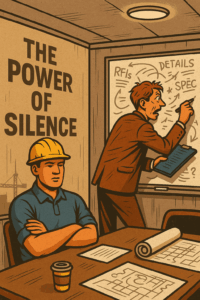
Silence is power.
It doesn’t shout. It doesn’t rush. It waits.
And in construction, that can be the strongest move you make.
We don’t talk enough about silence in construction.
We talk about deadlines. We talk about safety. We talk about schedule delays, material lead times, RFIs, conflicts, and change orders. But silence? That’s the one tool nobody trains you to use.
Yet in the field—in real moments that matter—it can be the most powerful move you make.
Whether you’re locked in a negotiation, sitting across from a contractor pushing for more time, or staring down a room full of frustrated stakeholders, the one who stays silent often holds the most power.
This post is about that power—how to harness it, when to use it, and when to shut up and let the silence do the talking.
Waiting for News: The Mental Toll of Silence
There’s a certain kind of silence that can eat you alive—the kind that shows up when you’re waiting for an answer.
- Waiting for a permit.
- Waiting for test results.
- Waiting for a change order to get priced.
- Waiting for a yes—or a no.
Why is that silence so hard? Because it gives your mind room to spiral. Human nature tells us to prepare for the worst. Our brains don’t fill silence with optimism. We play out worst-case scenarios. We imagine fallout. We brace for failure.
Then, when the bad news finally comes, we say, “I knew it.” But if the good news comes instead, the relief hits harder—because silence made the suspense feel even longer.
This isn’t just about stress. It’s about how silence amplifies. It makes both the highs and lows more intense.
And when used deliberately—it can shift power.
In Negotiations: Silence Is a Strategy
Negotiation happens constantly in construction. Pricing disputes. Scope clarifications. Change order talks. Payment draws. Contractor delays. Material substitutions.
It’s not always across a table with contracts in hand—sometimes it’s a quick back-and-forth in a meeting trailer. But every interaction has stakes. And one of the strongest tools you have?
Silence.
You make your point. Then you stop talking.
The next few seconds feel like forever—but you hold.
Because the person who breaks the silence first is usually the one under more pressure. And when they speak, they often:
- Over-explain their position
- Reveal uncertainty
- Offer concessions
- Say something they shouldn’t
It’s not about playing games. It’s about knowing that when you’ve said what needs to be said, the most powerful move is to stop talking and let it land.
Great negotiators aren’t just persuasive—they’re composed. And silence gives them control of the moment.
In Conflict: Silence Is Control
Silence also plays a critical role in conflict. Tension is part of construction—it shows up in field disputes, coordination meetings, inspections, and closeout.
Sometimes you’re challenged. Sometimes you’re insulted. Sometimes someone’s trying to bait you into a reaction.
Don’t give them what they want.
Responding too quickly—especially with emotion—often weakens your position. But choosing silence gives you something far more valuable: control.
- It allows the other party to speak first.
- It shows that you’re listening, not reacting.
- It gives you time to think—and when you do speak, your words carry more weight.
Silence can’t be mistaken for confusion when it’s used with intent. It becomes a signal: “I’m not rattled. I’m thinking. And I’m in charge of what comes next.”
Those Who Talk Too Much Usually Have Less to Say
The loudest person in the room isn’t always the most confident—they’re often the most uncomfortable.
You’ve seen it before: someone launches into a monologue, stringing together technical details, obscure references, and a dozen side points that may or may not relate to the issue at hand.
It might sound impressive. But it usually signals insecurity.
When someone lacks confidence in their position, they try to bury you in words.
They flood the conversation with volume, hoping to maintain control through confusion. It’s a form of misdirection—what logicians might call a red herring—where the real issue gets buried under irrelevant detail.
But in reality? The person who speaks the most is often avoiding the point.
Strong communicators don’t need to dominate the room.
They say what matters. Then they stop.
And they let silence do the rest.
Personal Reflection: Learning to Respect Silence
I’ll admit it—my younger self hated silence.
I trained myself to fill every gap in a conversation. On dates, I’d talk just to keep someone interested. On the jobsite, I tried to answer every question instantly—partly to prove I knew what I was doing, partly to show I was the guy in charge.
But as I’ve grown—in this industry, in my career, and in life—I’ve learned that the people with real strength don’t fear silence. They respect it.
Silence in a heated argument? That takes confidence. Silence after a tough question? That takes restraint.
The ones who panic in silence are usually the ones unsure of their footing. I’ve seen it—people rush to agree, make concessions, or say something they regret just to escape the discomfort. Especially when the other person has more perceived authority.
It’s survival instinct. But in this business, where leadership, negotiation, and decision-making are daily battles, we don’t have room for weakness.
Silence is strength.
How to Practice Silence Effectively
Like any skill, silence takes practice. It’s not about being passive or withdrawn—it’s about being intentional. Here are a few ways to build that muscle:
1. Pause After You Speak
After making your point in a meeting or negotiation, don’t rush to justify or explain. Let your words land. A few seconds of silence may feel awkward at first, but it shows confidence—and it invites others to respond before you over-talk your own position.
Pro tip: Count “one Mississippi… two Mississippi…” silently in your head. By the time you hit three, someone else will usually speak up.
2. Resist the Urge to Fill Awkward Gaps
Silence often feels uncomfortable—especially in tense conversations. But don’t mistake discomfort for weakness. People who can sit in silence without flinching often hold the most control in the room.
3. Use Silence as a Listening Tool
Don’t interrupt just to move the conversation forward. Let the other person talk—really talk. You’ll be surprised what people reveal when you leave space for them to fill.
4. Practice in Low-Stakes Conversations
Start using silence in everyday interactions—on phone calls, in casual meetings, even with friends. Get comfortable with the rhythm. Learn when to hold back and when to speak up with precision.
5. Match Silence with Intentional Body Language
Silence alone isn’t enough—pair it with confident posture, calm breathing, and eye contact. Your silence should communicate presence, not hesitation.
Silence is strongest when it’s backed by composure.
When Silence Backfires
Silence is powerful—but it’s not always the right move. Like any tool, it can work against you if used in the wrong context. Here’s when silence can backfire:
1. When It Feels Like Avoidance
If you’re silent for too long after a direct question—especially from your client or a key stakeholder—it can come across as disengaged, unprepared, or even evasive.
2. When It Leaves Room for Assumptions
In the absence of information, people create their own narratives. If you go quiet on a pressing issue—like a delay, safety concern, or cost overrun—you might lose control of the story. Communicate early and often, then use silence tactically in the discussion—not in place of communication.
3. When Confidence Crosses Into Arrogance
There’s a fine line between strong silence and smug silence. If you stay quiet just to assert dominance, or if you remain silent while others struggle to speak, it can feel manipulative or condescending.
4. When It Becomes Passive
In heated field discussions or conflict resolution, if you never speak up—or wait too long—you might lose your chance to influence the outcome. Silence is a tactic, not a substitute for courage.
Bottom line: Silence isn’t a universal answer. It’s a tool—and tools work best when you understand the context.
Final Thought
Silence is not absence. It’s not indecision. It’s not a lack of leadership.
In construction—where every second is filled with noise, pressure, and movement—silence stands out.
And that’s what makes it powerful.
Whether you’re walking a jobsite, sitting across the table in a negotiation, or taking heat in a project meeting, remember:
The strongest person in the room doesn’t need to fill the silence.
They own it.
If you liked this post, check out another post about the Chain of Command being a good defense against the Chaos in Construction
Discover more from Chaos in Construction
Subscribe to get the latest posts sent to your email.