
Every seasoned construction professional has crossed paths with one. They’re not the lead. They’re not the boots-on-the-ground authority. But somehow, they manage to flap their way into critical project moments, drop chaos into an already complex operation, and disappear before the dust settles.
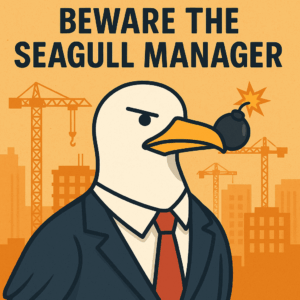
We call them: The Seagull Manager 🕊️.
🧱 What Is a Seagull Manager?
In construction, a Seagull Manager is someone with just enough authority—or perceived authority—to disrupt progress without contributing real value. They show up rarely, observe little, and then:
- Swoop in during key meetings or walk-throughs
- Squawk out vague or unrealistic directives
- Drop a mess of conflicting input, last-minute changes, or off-the-cuff demands
- Fly off without staying to help implement or clean up the aftermath
They often mean well. But good intentions don’t pour concrete, resolve RFIs, or realign procurement schedules. Their input usually bypasses the field team’s established coordination process—and that’s where the trouble begins.
💥 Why Seagull Managers Create Construction Chaos
Seagull Managers might be department heads, engineers, or outside stakeholders. They don’t fully grasp the current status or constraints but feel compelled to weigh in. The result?
- Bypassed communication channels
- Confused field crews and subcontractors
- Misaligned priorities
- Delays and rework
On a jobsite governed by coordination and sequencing, this kind of interference is more than annoying—it’s dangerous. If you’ve read my post on Parkinson’s Law on the Jobsite, you know how dangerous wasted time and vague direction can be.
📉 The Real Cost of a Flyby
Let’s be blunt. A single disruptive visit from a Seagull Manager can cost hours—sometimes days—of rework. In worst cases, it can push critical path activities, delay turnover, or erode trust in leadership.
Even more dangerous is the ripple effect across teams. When authority is confused and decisions seem to come from all directions, people stop trusting the chain of command. Momentum fades. Accountability blurs. And teams start protecting themselves instead of collaborating openly.
This is what I call a silent killer of jobsite culture—similar to the danger I wrote about in Information Silos on High-Performing Teams. Seagull-style leadership creates silos without ever realizing it.
🛠️ How Great Teams Handle the Seagull Effect
High-performing construction teams don’t just hope it doesn’t happen—they prepare for it. Here’s how you can contain the fallout:
- Define roles clearly. Spell out who has the authority to give direction, issue change orders, and approve scope decisions. Put it in the kickoff agenda. Repeat it often.
- Control access. Make it clear that visits or directives must flow through the project manager or superintendent. No side orders. No drive-bys.
- Document everything. Use daily reports or meeting minutes to record off-script input. If someone insists on field changes, capture it with a paper trail and note potential impacts.
- Use your schedule as a shield. When challenged, refer back to the schedule and sequencing logic. (Need help using your schedule as leverage? Check out my post on Construction Schedule Chaos.)
- Lead up. If a Seagull Manager is above you in the org chart, don’t ignore them—but do help them see the consequences. Offer to walk them through the impacts of their request on cost, schedule, and manpower.
👷♂️ Don’t Be the Seagull
If you’re in a leadership role—or want to be—check yourself:
- Are you visiting the jobsite enough to understand progress?
- Are your requests aligned with current constraints?
- Do you follow through on what you say, or drop and dash?
- Do you issue direction through the right channels?
Leadership isn’t about flying in and barking orders. It’s about guiding progress with clarity, context, and consistency.
So the next time you feel the urge to swoop in and “fix” a problem without understanding the full story—pause. Ask yourself: Am I helping? Or just flapping my wings?
🧭 Final Word
Construction chaos is inevitable. But unnecessary chaos caused by unclear authority and misplaced ego isn’t. A strong project doesn’t just run on logic—it runs on leadership.
Recognize the Seagull. Contain the effect. And if you’re in a position of influence—don’t be the bird that drops the bomb and flies away.
Want more lessons like this? Explore the rest of the Construction Chaos blog or subscribe for updates.
Discover more from Chaos in Construction
Subscribe to get the latest posts sent to your email.